
Artificial intelligence is changing how businesses create content, optimize websites, and approach search engine optimization (SEO). Tools like ChatGPT help marketers generate blog ideas, write drafts, and develop content strategies faster than ever before.
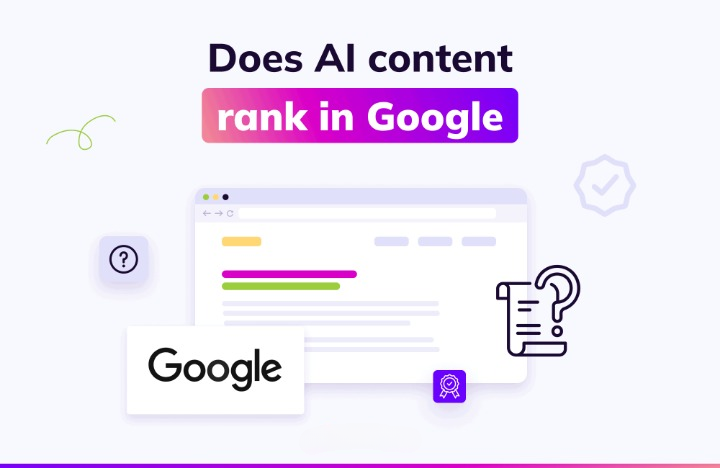
But an important question remains: Can AI-generated content rank on Google in 2026?
The answer is yes. AI-generated content can rank on Google when it provides helpful, reliable, original information that satisfies users’ needs. However, using AI to produce large amounts of generic or low-quality content does not guarantee rankings.
In this guide, we’ll explore Google’s approach to AI content, the benefits and risks of using AI for SEO, and practical strategies for creating content that supports long-term organic growth.
What Is AI-Generated Content?
AI-generated content is text, images, or other media created with the help of artificial intelligence tools.
In digital marketing, AI content is commonly used for blog articles, website copy, product descriptions, social media posts, email campaigns, and SEO content planning.
Popular AI tools can help businesses:
- Generate blog topic ideas
- Create article outlines
- Draft website content
- Suggest relevant keywords
- Improve readability
- Develop social media captions
- Write meta title and description drafts
- Repurpose existing content
AI can make content creation more efficient, but the final result still needs human review, fact-checking, and meaningful value.
Does Google Allow AI-Generated Content?
Yes. Google does not automatically penalize content simply because it was created using AI.
Google’s guidance focuses on the quality and purpose of content rather than whether AI or a human produced it. AI can be useful for research, structuring ideas, and creating helpful material.
However, Google may take action against content that violates its spam policies, including content created primarily to manipulate search rankings.
For example, publishing hundreds of automatically generated articles with little original value can fall under Google’s scaled content abuse policy, regardless of whether AI, humans, or a combination of both created them.
The key takeaway: Use AI to improve your content workflow, not to flood your website with low-value pages.
How Can AI-Generated Content Rank on Google in 2026?
To improve the chances of ranking, AI-assisted content should meet the same fundamental quality standards as other useful web content.
1. Focus on Helpful, People-First Content
Your content should answer the reader’s question clearly and provide practical value.
Before writing an article, ask:
- What problem is the reader trying to solve?
- What information do they need?
- Can the article provide a useful, complete answer?
- Does it offer something beyond existing search results?
For example, an article about AI SEO should explain how businesses can improve search visibility, provide actionable recommendations, and clarify what AI search optimization can and cannot achieve.
Avoid creating content simply to include keywords.
2. Add Original Insights and Experience
One of the biggest weaknesses of unedited AI content is that it can sound generic or repeat information already available online.
Make your content more valuable by including:
- Original research and statistics
- Practical examples
- First-hand experience
- Expert commentary
- Real case studies
- Unique observations
- Lessons from actual campaigns
For a digital marketing agency like Creobees, explaining how specific SEO strategies work in real business situations can help distinguish your content from generic AI-generated articles.
Never invent case studies, client results, testimonials, or personal experiences.
3. Optimize Content for Search Intent
Search intent describes what a person hopes to accomplish when entering a query.
For the keyword “Can AI-generated content rank on Google?”, users typically want to know whether AI content is permitted, whether it can perform well, and how to create it effectively.
Your article should address these questions directly.
Use clear headings, relevant examples, and concise explanations to help readers find the information they need.
Matching search intent is more useful than repeatedly inserting the same keyword throughout an article.
4. Use Relevant Keywords Naturally
Keyword optimization remains an important part of SEO, but content should read naturally.
For this topic, relevant keyword ideas include:
- AI-generated content SEO
- Can AI content rank on Google
- AI content and Google rankings
- AI writing tools for SEO
- Google AI content guidelines
- AI content optimization
- AI SEO best practices
Include your primary keyword in appropriate locations, such as the title, introduction, and a relevant heading where it fits naturally.
Use secondary keywords only when they contribute to the article’s meaning. There is no need to target a specific keyword density.
5. Verify Facts and Information
AI tools can produce incorrect facts, outdated information, and unsupported claims.
Before publishing, verify:
- Statistics and research findings
- Industry developments
- Technical recommendations
- Product details
- Legal or policy statements
- Links and references
For SEO-related articles, refer to Google’s official Search Central documentation when explaining search guidelines.
Accurate information improves reader trust and reduces the risk of publishing misleading advice.
6. Improve Readability and Content Structure
Even useful content can be difficult to understand if it is poorly organized.
Make your article easier to read by using:
- Clear H2 and H3 headings
- Short paragraphs
- Bullet points where appropriate
- Relevant examples
- Descriptive links
- Tables for useful comparisons
- A logical introduction and conclusion
Avoid unnecessary repetition and overly long introductions. Answer the main question early, then provide supporting details.
7. Strengthen Your Website’s SEO Foundation
High-quality content is only one part of a successful SEO strategy.
Your website should also have:
- Mobile-friendly pages
- Fast loading speeds
- Crawlable and indexable URLs
- Descriptive title tags
- Relevant internal links
- Secure HTTPS
- A clear site structure
- Useful navigation
Link your blog posts to related articles and service pages on your website. For example, this article could link to your SEO services, AI SEO articles, and content marketing pages.
These practices help users navigate your website and support search engines in discovering your content.
8. Update Content When Necessary
AI, SEO, and digital marketing change over time. An article can lose relevance if its facts, examples, or recommendations become outdated.
Review important content periodically and update information when there is a genuine reason to do so.
Useful updates might include new research, corrected information, improved examples, or changes to official search guidance.
Avoid changing publication dates merely to make an article appear fresh when its content has not meaningfully changed.
AI-Generated Content vs. Human-Written Content
Both AI-assisted and human-written content can perform well in search. Neither approach automatically guarantees better rankings.
| AI-Generated Content | Human-Written Content |
|---|---|
| Can speed up drafting | Can incorporate first-hand experience naturally |
| Helps brainstorm many ideas | Can provide original expert perspectives |
| May require extensive fact-checking | Still requires fact-checking |
| Can sound generic without editing | Can also be generic or poorly researched |
| Benefits from human review | Benefits from research and editorial review |
In many cases, a combined approach works well: use AI to support research and drafting, then apply human expertise to improve accuracy, originality, relevance, and usefulness.
Does Google Penalize AI Content?
Google does not automatically penalize content because it was generated by AI.
However, content that violates Google’s spam policies may lose visibility or receive other enforcement actions.
One important policy is scaled content abuse. This concerns generating many pages primarily to manipulate search rankings and provide little value to users. The policy applies regardless of how the content is created.
Other risky practices include:
- Copying or lightly rewriting other websites’ content
- Publishing misleading information
- Creating pages without meaningful purpose
- Producing content designed primarily to manipulate rankings
- Using automated techniques that violate spam policies
Focus on publishing content that serves a clear purpose and benefits your audience.
Best AI Tools for SEO Content Creation
AI tools can support different stages of the content creation process.
ChatGPT
Useful for brainstorming blog topics, creating outlines, drafting content, developing FAQs, and improving readability.
Google Search Console
Helps monitor search impressions, clicks, indexing, and performance for queries and pages on your website.
Google Analytics
Helps evaluate website traffic, engagement, and conversions when configured appropriately.
SEO Research Tools
Platforms such as Semrush and Ahrefs can help research keywords, evaluate competitors, and identify potential content opportunities.
These tools serve different purposes. AI writing tools assist with content workflows, while analytics and SEO research tools help validate performance and guide decisions.
A Practical Workflow for Creating SEO-Friendly AI Content
Follow this process when creating your next blog post:
Step 1: Research the topic. Understand your audience, search intent, and the questions readers want answered.
Step 2: Validate keyword opportunities. Use SEO research tools to evaluate relevant keywords and search demand.
Step 3: Create an outline. Organize the article into logical sections that fully address the topic.
Step 4: Use AI for drafting. Generate a first draft or develop selected sections with clear instructions.
Step 5: Add original value. Include verified facts, expert insights, practical examples, and useful recommendations.
Step 6: Edit and fact-check. Remove repetition, correct errors, and ensure the article matches your brand voice.
Step 7: Optimize the page. Review headings, title tags, meta descriptions, internal links, and technical accessibility.
Step 8: Monitor performance. Use Search Console and analytics to understand impressions, clicks, traffic, and conversions. Improve the content when the evidence supports doing so.
This workflow helps combine AI’s efficiency with the editorial judgment required for quality content.
How Can Businesses Benefit From AI Content for SEO?
When used responsibly, AI can help businesses develop content more efficiently and maintain a consistent publishing process.
Potential benefits include:
- Faster content ideation and drafting
- More organized editorial planning
- Support for keyword and topic research
- Easier content repurposing
- Improved workflow consistency
- More time for strategy and quality review
However, publishing more content does not automatically lead to more traffic. Results depend on relevance, quality, competition, technical SEO, and how well the content serves the audience.
The Future of AI Content and SEO
AI is likely to remain an important part of digital marketing. Businesses can use it to improve productivity, explore ideas, and support content development.
At the same time, useful information, originality, credibility, and a good user experience remain essential.
Instead of asking only how much content AI can produce, businesses should ask how AI can help them publish better content.
A sustainable SEO strategy combines AI-assisted workflows, human expertise, technical optimization, and a clear understanding of customer needs.
How Creobees Can Help You Grow With SEO
At Creobees, we help businesses strengthen their online presence through SEO, content marketing, social media marketing, PPC advertising, and data-driven digital marketing strategies.
Our approach focuses on understanding your audience, creating useful content, improving website visibility, and attracting potential customers through relevant marketing channels.
Whether you want to improve organic rankings, develop a content strategy, or explore AI-assisted marketing workflows, we can help you identify opportunities aligned with your business goals.
Ready to Improve Your Website’s SEO?
Build a stronger digital presence with a strategy focused on helpful content, search visibility, and sustainable growth.
Contact Creobees today to explore our SEO and digital marketing services.